Chapter 11:
Loyalty to the Kingdom— Part 2:
Self-defense
Military leaders admit: war is a poor way to solve problems.* Those familiar with the devastation it leaves behind are usually reluctant to take that route; nevertheless, they give in to the political or social pressure to respond in kind or to mount a preemptive attack. Sometimes it seems as if an invisible hand pulls groups of people into a disastrous confrontation, and no one has the moral power to resist it, to find a better way. Would that invisible hand be God? No. Rather, it is the "god of this world", Satan.— 2 Cor 4:3, 4.
But what if we are attacked? Does God put an invisible shield around his loyal ones? Within limits, yes, he does. Pilate said to Jesus: “Do you not know that I have authority to release you and I have authority to execute you?” Jesus answered him: “You would have no authority over me at all unless it had been granted to you from above.” (John 19:10, 11) Earlier, when Peter had valiantly tried to use a sword to protect Jesus from an armed mob, Jesus told him: “Return your sword to its place, for all those who take up the sword will perish by the sword. Or do you think that I cannot appeal to my Father to supply me at this moment more than 12 legions of angels?” (Matt 26:51-53) Jesus felt quite secure, very well protected indeed. Yet he died very painfully just a few hours later. Was he a fool?
No, he was the Son of God. He knew exactly what he faced*. Likewise, we are well protected. On his last night with his disciples, Jesus asked of his Father: "Watch over them because of the wicked one. . . the world has hated them, because they are no part of the world." (John 17:11-16) We do not know if God will always intervene to deliver us from death, but we know He can, and will, if it should be. If he chooses to let us be martyred for our faith, we have to accept that. We trust his promise to raise us up, as he did his Son. —recall Daniel 3:17, 18; see also 1 Pet 2:21-23, 2 Kings 6:15-23, Psalm 37:39, 40, 27.3, and 34.7, 15-19, and Psalm 91. (There are in fact dozens of scriptures that reassure faithful ones of God's protective care.)
Of course, not all danger comes because we are Christians. We may be attacked by an animal, or by a criminal or mentally disturbed person. Can we forcefully defend ourselves? Yes. Jesus himself instructed his disciples to prepare for the Christian ministry: “Let the one who has a money bag take it, likewise a food pouch, and let the one who has no sword sell his outer garment and buy one. Then they said: ‘Lord, look! here are two swords.’ He said to them: ‘It is enough.’” (Luke 22:36-38) It was later that very night that Peter tried to use one of those swords to defend Jesus against the mob of fanatics. Yet Jesus sharply rebuked him for doing that, saying "all those who take up the sword will perish by the sword." So why did he tell them to have one? Was it just to teach this lesson, and lesson learned, they should now get rid of them and go on unarmed?
No, the advice to carry a sword was clearly for their future work*. And having one does imply a reason may exist to use it. We see that God does not authorize us to fight the government or an overwhelming mob of religious fanatics (and any such attempt would likely end badly anyway.) On the other hand, defending oneself, one’s family, or an immediate neighbor from a smaller threat, perhaps a lone attacker, may be valid cause to use a weapon. Whether to fight or flee or call for authorized force is a judgment God leaves to us. We do have to remember that we will have to account to him either if we misuse our "sword" by overreacting with rash violence, or, on the other hand, if we were to do nothing to defend an innocent one being attacked when we had the means to do so. So our conscience should not paralyze us with uncertainty from undertaking vigorous and effective physical defensive action where it is permissible.
The modern equivalent of the sword is the firearm. People who know guns well admit that they have limited usefulness in close defense situations. Most attackers don’t phone ahead; they usually have the drop on their victim. The best defense is a calm heart (faith gives us that) and a smooth tongue (being a Christian is supposed to help us speak well: Col 4:6, also see Prov 15:1 and 25:15). These "spiritual weapons" often defuse anger, preventing an attack altogether. By far the greater number of fights in this world are due to belligerence on both sides; since Christians are peaceable "as far as it depends upon them", they miss a lot of action. They aren’t complaining. —see Rom 12:18, 1 Pet 3:13-17.
If we choose to carry any weapon or to have some awareness of defensive techniques, we have to guard against the natural tendency to feel too confident, to put our trust in arms rather than in God. Further, sad experience shows that easy access to a lethal weapon greatly increases the chance of it being used inappropriately, such as in a moment of anger or despair, or by curious children. Finally, owning a weapon may prove more provocative than protective. Some antagonists regard such preparedness as a challenge to be confronted, not respected. On balance, we find we get more respect as a peaceful, confident Christian. In effect, we meet carnal warfare with spiritual weapons. Yes, it works. Yes, it takes serious faith. —Revelation 13:7-10, Isaiah 30:15.
As for facing a mugger who wants no more than valuables, Christians estimate material things as highly disposable. We are cautioned not to get emotionally attached to any material property, since we will probably lose it all in the chaos of the Great Tribulation anyway. Our eyes are on the wonderful things of the new world to come. —Heb 10:34.
Proverbs 4:23 tells us what is the most important self-defense by far: “Above all the things that you guard, safeguard your heart, for out of it are the sources of life.” How do we do that? Science says, by diet and exercise. Quality food, and avoiding unhealthy things such as excess sugar, also worry, and keeping the rest of the body in tone, are proven good habits for heart health. But in scripture, "heart" usually means your inner self, your spirit, your attitude and motivations. What is a healthy "diet" and "exercise" for that heart? Proverbs 2:10-15 answers: “When wisdom enters your heart, and knowledge becomes pleasant to your soul, thinking ability will keep watch over you, and discernment will safeguard you, to save you from the bad course, from the man speaking perverse things, from those leaving the upright paths to walk in the ways of darkness, from those who rejoice in wrongdoing, who enjoy the perverseness of evil.” Verses 2-6 tell us how to find this wisdom: “Accept my sayings and treasure up my commandments, by making your ear attentive to wisdom and inclining your heart to discernment ... if you call out for understanding and raise your voice for discernment, if you keep seeking for it as for silver, and you keep searching for it as for hidden treasures, then you will understand the fear of Jehovah, and you will find the knowledge of God. For Jehovah himself gives wisdom, from his mouth come knowledge and discernment.” (See also Prov 9:10.) Simply put, you live a lot longer being smart than being violent. In fact, God’s wisdom gives us life forever.
Justice and Revenge
Some misunderstand Jesus’ words at Matthew 5:38, 39: “You heard that it was said, ‘Eye for eye and tooth for tooth.’ However, I say to you: Do not resist the one who is wicked, but whoever slaps you on your right cheek, turn the other also to him.” "Eye for eye" was God’s Law, and Jesus was not telling us to disrespect that. (see Deut 19:16-21) But this law of talion, as it is called, was meant to be applied by the established judicial system. It did not sanction personal retaliation, it did not excuse personal revenge. Unfortunately that misuse of the law did arise, so Jesus spoke.
Some believe Jesus here forbids self defense, but protecting oneself from injury is not the issue. We may do that quite vigorously, as noted above. Rather, he is teaching us to have a peaceable frame of mind: we are not to be "macho", easily goaded into a fight by every minor provocation. A slap is meant to injure our pride, to get a fight started. Some have said, ‘if your enemy slaps your cheek, turn the other; when he slaps that one, deck him.’ And it is true, patience does have its limits. Unfortunately, a provocateur often is bold because he has an edge we do not see; once the fight begins, we may fare badly. God gives us a more effective way of dealing with a belligerent: by an unexpectedly calm reaction (thereby showing strength, not fear) we may defuse a volatile situation and even "conquer evil."
At Romans 12:17-21 we find one of the most difficult passages of scripture to obey: "Return evil for evil to no one. . . do not avenge yourselves. . . if your enemy is hungry, feed him." If we exercise this self-restraint, what effect may we have? "By doing this you will heap fiery coals on his head." Ah, that sounds like sweet revenge. But it is not. Paul here is alluding to the way metal ore was refined: coals were heaped over the ore to intensify the heat, and the desired metal would come flowing out. So, if we respond to provocation as God instructs, we ‘pour the heat on’ our enemy’s conscience, if he has any trace of one left, and reduce or eliminate the conflict.*
But as God’s law of talion clearly states, there can be a time for vengeance. While God forbids us from taking revenge personally, he says, "Vengeance is mine, I shall repay." He may do that himself, and "it is a fearful thing to fall into the hands of the living God." (Heb 10:30, 31) God may also choose to use authorized agents to punish wrongdoing, as Paul goes on to explain at Romans 13:1-4. There ungodly governments of the world are called "God’s minister [servant], an avenger to express wrath upon the one practicing what is bad." In fact, for this purpose it "bears the sword." So, although they may disregard and offend God in many ways and will meet their own destruction in due time, worldly powers do serve God’s purpose when they maintain order by punishing wrongdoing, even when that includes capital punishment. With that sword it may kill with God’s approval. Of course, they sometimes do it unjustly, even against God’s innocent people, and for that they will have to answer. But God does not condemn them when they do it correctly.
Does that include war? The evidence from scripture says yes, although very few of the many, many wars fought have served God’s will. And even those that did, also usually went on to inflict suffering for which the perpetrators were condemned. A case in point is Assyria when it devastated Israel. Jehovah calls Assyria "the rod for my anger" against the "apostate nation" (Israel). (Isa 10:5-7) Yet in the same context Isaiah continues, "when Jehovah finishes all his work on Mount Zion and in Jerusalem, He will punish the king of Assyria for his insolent heart and his proud, arrogant gaze." (vs 12.) In our time the day will soon come when Satan will maneuver all the militaries on earth to fight against God. Which side of that fight do you want to be on? —Rev 19:19.
National service and taxes
So then, should Christians join national defense organizations? Christians consider Psalms 33:16-19: “No king is saved by a large army; a mighty man is not saved by his great power. The horse is a false hope for salvation; its great strength does not ensure escape. Look! The eye of Jehovah watches over those fearing him, those waiting for his loyal love, to rescue them from death, and to keep them alive.” And Isaiah 31:1: “Woe to those who go down to Egypt for assistance, who rely on horses, who trust in war chariots because they are numerous, and in warhorses because they are mighty. But they do not look to the Holy One of Israel, and they do not search for Jehovah.” Israel was at that time turning away from Jehovah, looking instead to Egypt, a pagan nation, as a savior because of its military strength. Nations today may say, "In God we trust", but do they really? What does their behavior prove? We learn from the mistake that the Israelites made, and do not put our faith in the military might of ungodly governments. —Compare Micah 3:9-11, Jer 17:5.
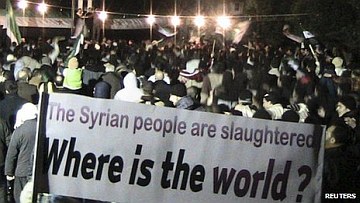
Despite its limits noted earlier, in this world sometimes violence is the only way to suppress determined evil or to rescue innocents from oppression. Christians benefit along with everyone else from such police or military force.* Even so, when we look closer we invariably find that the use of force was a belated response made necessary by neglect, or worse, by years of selling arms into local conflicts. Witness the mass slaughters in Rwanda, the Balkans, Cambodia, Iraq, and Sudan: all tolerated, winked at, ignored, allowed to drag on and milked for profit until there is almost no one left to save, and then someone has the bright idea to go in with guns blazing, spending billions of dollars destroying infrastructure and lives to bring "peace." After a few episodes of this, one would think the world would learn something about prevention, but no; how could they make money off that?
Christians should not join this "necessary violence," even if it may accomplish a good end or two amidst the destruction. We stick to the better path God has given us. We do far more to defend any country and serve mankind by rooting out of men's hearts the evils of ignorance, pride, deceit, selfishness, and indifference to morality, than could ever be accomplished by killing people and blowing up buildings. Such evils cannot be fought with heavy artillery. "Smart" bombs are useless against the stupidity of Godlessness.
What if the government conscripts us for work it considers necessary for national defense? Jesus gave us this guidance: "if someone under authority impresses you into service for a mile, go with him two miles." (Matt 5:41) In those days Roman soldiers moved from posting to posting by walking, and they had the authority to commandeer any handy bystander to carry their load for a mile. It is not likely he would entrust the civilian with his weapons; rather, such one would carry the provisions and personal gear. So Christians do not balk at obligatory service, even if it has a peripheral connection to government activities they disapprove. Of course, that does not mean we ask no questions and accept any assignment! Our response depends on the purpose of the work requested of us. We may be able to serve in good conscience if the road, bridge, hospital or whatever being built, has legitimate civilian or humanitarian use and does not directly enable violence or oppression. If others so misuse it later, they will be the ones to bear judgment.
Of course, we feel no need to volunteer for such service. We already have a most honorable assignment, the Christian ministry. Our ministry serves the security of all nations, as already mentioned, by teaching things fundamental to good citizenship— morality, diligence, active concern for one’s neighbor. Unfortunately, no nation as a whole will take the position of real security, on God’s side. We do not labor under the illusion that our work will reverse the tide of godlessness overtaking mankind.
In Jesus’ day, Rome dominated Palestine with a sometimes heavy hand. So Jews asked Jesus: ‘Should we pay taxes to Rome or not?’ Although some of that tax money went to maintain infrastructure useful for commerce, for the most part it supported the Roman military and political machine. And of course, a considerable amount slipped into corrupt pockets, just like today. The Jews hated being forced to give up their hard-earned income to pay for such things. Did Jesus therefore say it was immoral to underwrite such works, that this was a moral point on which to take a stand? No, he pointed out that the money was minted by Caesar, and said "pay Caesar’s things to Caesar, and God’s things to God." (Luke 20:22-25.) In effect, that money was never really theirs, despite all the work they went to to get it. Jesus tells us to "work, not for the food that perishes, but for the food that remains for life everlasting." Our focus should not be on acquiring wealth in this unjust world. It is better to keep our material affairs simple and modest. This also tends to minimize taxes, although some are demanded for simply existing. See Matt 6:19-21, 31-33, John 6:27.
What if taxes are excessive and oppressive? Christians do not foment revolt, but that does not mean we have to accept mistreatment quietly. There are legal ways to protest injustice. And if "Caesar" targets taxes specifically at Christians to destroy them, he will find he has a higher power to reckon with. God may allow us to be oppressed for a time, but he does not allow us to be crushed out of existence. See 2 Cor 4:7-9, Isaiah 41:10-13.
So we do not cheat; if we can, we pay whatever tax the government imposes. We know they use some of it well and much of it quite badly. But we are not authorized to check their books and pay only the part we approve of. They face their judgment for what they do with it. We are free of that. (As mentioned earlier, one useful service paid for by taxes is a degree of law and order. See Romans 13:3-6.)
Of course, if the tax laws are so byzantine that not even a tax lawyer can understand them, a Christian cannot be morally faulted for not complying perfectly (although you can be sure the government will.) A good faith effort is sufficient. Jesus is not asking us to make tax obedience our religion.
The situation is a bit different if the government says a tax is specifically for one purpose, and it officially considers those who pay the tax as approving supporters of that purpose. In that case, as with national service, we have to conscientiously consider what that work is, and decline to directly underwrite any evil end. In telling us to pay taxes, God is not asking us to bow before evil, meekly submitting and serving it. If they challenge us to take a stand, we must do so. As an example of this, some years ago in Malawi (Africa) the one-party dictatorship required all to pay 25¢ for a "party membership card." We would have readily given them 25¢ to spend as they saw fit, but because they officially declared it as signifying an allegiance that we did not hold, we had to refuse. "Why make an issue over a few words?" some might say. "Just mumble your ‘Heil Hitler’ and be done with it, they don’t have to know you don’t really mean it." But words mean a lot to God. Matthew 10:32-39, quoted earlier, tells us that God will not excuse us: we must openly declare our loyalty to God and his Kingdom regardless of the pressure to compromise.* (See also Matt 12:37.)
Jehovah does not accept divided loyalty. The first two of the Ten Commandments show how important this to Him: (1) "You must not have any other gods before my face. (2) You must not bow down to [any form of creation]. . . I Jehovah your God am a God exacting exclusive devotion."
Jesus says knowing God means everlasting life. (John 17:3) Knowing God means knowing this: a Christian cannot pledge fealty to ungodly men, saying ‘I will do anything you command.’ Or as it is sometimes put, "My country, right or wrong." This is another reason Christians have always refused to belong to the organized militaries of this world: the very first thing new soldiers are taught is reflexive obedience to orders. Any tendency to ask questions before obeying, such as might be caused by having independent moral judgment, is drilled out of them in boot camp. Submission and conformity is established and enforced by fear, team loyalty, and other psychological manipulation.* A Christian cannot allow his conscience to be subverted, or yield it to a worldly government; that would be a direct denial of God’s superior authority. (Of course, the military does not suppress all intelligent thinking ability, since such is useful to them. But try resisting an order, and you will quickly find out how much freedom you really have.)
As any combat veteran knows, the battlefield is no place for naunced moral assessments. It is shoot first or die. That is why there is so much "collateral damage" from "friendly fire." During World War II it was found that only about 20% of new soldiers would shoot to kill when ordered to do so. Their upbringing gave them a psychological barrier against taking another person's life. This caused considerable casualties when the enemy had no such inhibitions, so the military now have soldiers practice wanton slaughter with violent computer "games" similar to the popular Grand Theft Auto. Now they can boast an initial "willingness to fire," as they call it, of near 90%. A Christian sees this as a ruining of the heart and want no part of it.* Rather, they want to be part of the prophecy (mentioned earlier) ‘In the final part of the days [which is right now], God will instruct us about his ways, and we will walk in his paths. He will render judgment among the nations and set matters straight respecting many peoples. They will beat their swords into plowshares; nation will not lift up sword against nation, they will not learn war anymore.’ (Isaiah 2.2-4) Are you letting God teach you now? Who would the opposite instructor be?
Another point: The world admits openly, "the first casualty of war is the truth." Or as Sun Tzu put it in The Art of War, "All warfare is based on deception." That of course should never be true of the Christian's spiritual warfare, but it is a practical fact for literal war. National leaders lie to the enemy of course. They also lie about the enemy, to their own soldiers and citizens. They lie to their own people about how the war is going and what cruel excesses they are committing in their pursuit of victory. The very purpose of the war may be a lie. "The glorious liberation of the Fatherland" may actually be a grab for a weaker neighbor's oil fields. How could a true Christian, who "conducts himself honestly in all things," have any part of that?* (Heb 13:18) Consider this quote from a letter of an American soldier in North Africa during WWII: "It is a very, very horrible war, dirty and dishonest, not at all that glamour war that we read about in the hometown papers. [As] for myself and the other men here, we will show no mercy. We have seen too much for that." His feelings were no doubt a response to the viciousness and duplicity of the enemy he faced, but note that this changed him to become very much like that himself.