Chapter 3:
Getting Acquainted with God’s Word
If you open your Bible to the table of contents, you will notice that it is divided into two main sections, often called the "Old" and "New" Testaments. The older part was written mostly in Hebrew, so we call it the "Hebrew Scriptures." The later portion was written by followers of Christ in the international language of its time, Greek, so we refer to it as the "Christian Greek Scriptures."
The Bible was written in the Middle East starting about 3500 years ago. All of it was written or compiled by the descendents of a man named Abraham. Despite this, the Bible does not teach that God approves only of those in one privileged family or nation. —see Acts 10.34, 35, Mark 13.10, Isa 56.6, 7.
Some say that we need only the "New Testament" now, but actually the "Old Testament" is not outdated or of interest to Jews only. These two parts complement each other. Many prophecies in the first part were fulfilled in the Christian scriptures, and there are some prophecies that are only now undergoing fulfillment. Also, many teachings in Christianity can only be understood with knowledge of details found in the Law and history of Israel. It is true that the Christian scriptures clearly say that the Law, which was a complete covenant given by God to the Israelites, is no longer binding on anyone. But that law does remain valuable as a source of principles: it reveals how God feels about justice. For example, one law required that foreigners be treated fairly; another required a thief to compensate for what he stole. These are still good laws. In Christianity, we have the "law of love," which sums up all the other Law. One only needs to know what "love" really means. —see Galatians 3:23-25, Hebrews 8:6-13; Exodus 23:9, Numbers 15:16, Exodus 22:9, Leviticus 6:1-5; Romans 13:8-10.
The Bible is actually a library of 66 books, written by 40 different men over a period of 1,600 years (from about 1500 BCE to about 100 CE). Many of these men stated outright that what they wrote was from God. [2 Sam 23.2, Joel 1.1, etc] Some books are largely an account of events (Genesis, Exodus, Numbers, Joshua through Nehemiah, Acts), some give detailed laws (Leviticus, Deuteronomy), three are mostly poetry or songs (Job, Psalms, Song of Solomon), many are warnings, judgments and prophecy (Isaiah through Malachi, Revelation). Four recount the life of Jesus (Matthew, Mark, Luke, John), twenty-one are counsel and exhortation by his apostles (Romans through Jude). Proverbs and Ecclesiastes are the distilled wisdom of Solomon.
For many years the Bible had what would seem a very precarious existence. It was hand-written on perishable materials and had many powerful enemies, including wicked clergymen, who tried very hard to destroy it. Yet it inspired such loyalty and devotion that many risked their lives to copy it laboriously by hand so that it would survive. After the printing press was invented, copies could be made faster than enemies could destroy them. Today you may have several Bibles in your home. Do you appreciate the effort it took to make that possible?
You may be wondering why any clergyman would want God’s Word destroyed. Well, the Bible is very straightforward in condemning false teachings and those who would raise themselves up to oppress their fellowmen. [for example, see Matt 23.1-12.] Yet often the church hierarchies have conspired with political rulers to maintain systems that allowed them to live in luxury off the slavish labor of the common people. We still see such systems in place in some nations today. One way to pacify the people is to teach them that such an arrangement is "God’s ordaining," the way things are supposed to be. Anyone with access to the Bible would quickly find this to be a damnable lie; hence the efforts to deny the common people access. —James 5.1-6, Jer 22.13-17.
Today the Bible is readily available, but few people read it. Many of the clergy continue, in ways both subtle and not so subtle, to discourage careful Bible reading. But do not let anyone hinder you from learning all that God has revealed in his word.
One subtle way that clergy interfere with Bible understanding is by thoroughly imbedding their traditional interpretations of scripture as prejudices into the minds of their flocks, by constantly repeating them from the pulpit and in conversation.* Then as these sincere people read their Bible quietly at home, seeking to understand it as they should, they usually do not notice in verses details that prove those traditions wrong. We all tend to see only what we expect to see. To overcome that, it is essential to study with a truly searching heart. We should respect scripture, not be suspicious, skeptical, or critical of it, but at the same time we should be open to the possibility that what others have told us it means could be off a bit. Do not get discouraged and think it is impossible to know what is true. It might take a while, you may have to admit that you can't understand something presently, but God wants you to keep at it. He will reward sincere persistence.
When you hear that different people see a topic in seriously different ways, instead of choosing a side because your friends are there, carefully compare the verses one puts forth beside those promoted by the other, and go further to see if there are yet other verses that clarify the conflict. Never let anyone push you into accepting something by telling you you must believe or else (you will burn in hell/be thrown out of the church/make your mama cry/whatever.) That is an effective tactic often used, because it works, on those who are not really seeking truth. Another tactic is to quickly read you one verse as "proof" then declare they have proved their point, when you could see they have not, were you given time to think and compare other verses. A good and patient teacher lets you read a verse yourself, asks you what you see in it relating to the topic being considered, and brings in other verses that expand on and modify what the first verse says. A good teacher never raps your knuckles for a "wrong" answer.
As you study, be wary of your feelings. God's word can be like a mirror, and sometimes we don't like what we see. Rather than turn away or skip that part, let it push you to be a better person. Some people avoid the Bible entirely, because they know it condemns what they are doing. But how foolish it is to miss out on the wonders it holds just to cling to some dirty habit!
Again, as mentioned in Chapter 2, you are not the first good person to read the Bible. God now has an organized people who are patiently and carefully teaching its essential message. This web book is just one small example of their effort. —Proverbs 2:3-5, Hebrews 11:6.
Are Bibles Today True To The Original?
The Bible has been translated into almost every language on earth. In English there are at least 10 versions commonly available, and many others have been published. Why so many? you may ask. It is not easy to translate all the fine nuances of Hebrew and Greek into English. Every new translation represents the effort of a different group of translators to bring out the meaning in a way that you and I can understand and appreciate. It is therefore often helpful to compare several translations when trying to understand a difficult verse or teaching.
Sometimes translators allow their prejudices (or ignorance) to color their rendering of a verse here and there. This can be discovered by making comparison to other versions. However, even in Bibles with these few defective verses, it is easily possible to come to a correct understanding simply by taking into account the many other verses that testify on the subject involved. Specific examples will come up in later chapters of this book.
Some have said that we cannot rely on the Bible’s accuracy because it was copied by hand for so many centuries, and this allowed copyist mistakes (such as missed or mispelled words) to accumulate. It is true that some mistakes have been noticed in the old hand-written copies still in existence. Most of these mistakes are of no consequence. For example, did you notice that the word "mispelled" above was misspelled? The error did not lead to a wrong understanding, did it? The same is true of most scribal errors. Further, copying was done in many nations. An error in one copy is rarely found in another, except for copies of the defective copy itself. There are literally thousands to check by. So it has been a fairly easy matter to discern what the original reading was.
When the Dead Sea Scrolls were found, it became possible to compare our later copies of the Hebrew scriptures with those much older versions. Although the Scrolls were a thousand years older than the next newer copies available, only very small differences were found, mostly variations in spelling. This testifies to the extreme care that copyists took to do their work well. It also confirms our faith that God was watching over his Word to see that it remained available to mankind. —Ps 12.6, 7.
Is The Bible Really Inspired Of God?
Obviously, it claims to be. The only way for you to become convinced of it is to become acquainted with it. That is the purpose of this book. Here we will name 5 reasons to believe that the Bible is indeed inspired. As you study the Bible, you will find these proven true many times over. As a mnemonic, we have arranged them for this sentence: "HAPPIness comes to those who obey God’s word."
H stands for Harmony. Despite being written by 40 men over 1,600 years, the Bible is not a hodge-podge of conflicting views. Rather, it presents a harmonious view of God and his purposes. Of course, in casual reading, some get a different impression. Some search the Bible just to find difficulties, so as to dismiss it. Yet for every supposed contradiction of any substance, reasonable persons have found logical explanations. Only minor contradictions remain (such as variations in numbers given in parallel accounts of an event) and these can be explained as viewpoint difference or later copying error; none affect the overall meaning.
One "contradiction" often put forth is "where did Cain get his wife?" The Bible says Adam and Eve were the first humans. Then they had two sons. Cain, their first son, killed his brother Abel and was banished to a distant land. There, the King James version says, he "knew his wife." (Gen 4:8-17) Because no other children were mentioned, the casual reader assumes that this wife, and the other people Cain thought might harm him, were from some pre-existing population; so they jump to the conclusion the Bible is wrong about Adam being the first man, and so what else can we trust in it? The solution lies in trusting the Bible when it says at Gen 3:20, "Eve was to become the mother of everyone." Hence Eve must also be the mother of Cain's wife*; the fact this birth was not recorded does not prove it did not occur. This is fully as logical as the other explanation, and has the advantage of not requiring we discard the greatest Book ever written and declare its account of God a myth. Of course those determined to do that will choose the view that satisfies them. Granted, the story would have been 'neater' from our vantage point if every pertinent detail had been included; unfortunately, you will find that the Bible often leaves it to the reader to assume certain details as obvious. We have what we have, and when you meet your Maker you may complain, if so inclined at that time.

A stands for Accuracy. When the Bible mentions a city or nation, it really existed. Time and again archaeologists have had to retract claims of Bible error when they finally found and confirmed the places mentioned. The same is true of persons, events and dates. Even in matters of science, the Bible has proved true. For example, it said the earth was a "circle" or globe, and was "hanging upon nothing," at a time it was common belief that the earth was flat and carried by a giant. —Job 26.7, Isa 40.22.
P the first P stands for Practical. When the laws and principles of the Bible are carefully and conscientiously applied, the quality of life is vastly improved. It leads to peace, prosperity, improved health, and contentment. For example, the world considers marital fidelity unimportant, but the Bible requires it. How much heartache and violence would be avoided by being faithful! The Bible teaches honesty. How many trillions of dollars spent on security fences, locks, surveillance systems, weapons and the like could be saved if this were respected? Is the Bible impractical for expecting such virtues? No. Millions have lived by these principles at least to some extent, and the result is: Civilization. Today’s world is deeply distressed because so many have abandoned the civilizing virtues. The Bible is not to blame for that. It still says the same thing it always has.
P the second P stands for Prophecy. The greatest proof that the Bible is really from God is its perfect record in foretelling the future. It has foretold major events important to world history, things which are now a matter of record: they came true. The exactness is so remarkable that some insist that the prophecies were written after the event. Yet that has been proven false. For example, there were many details concerning the life of Jesus foretold in scripture unquestionably written before his lifetime: that he would be born in Bethlehem, of a virgin; that he would be unjustly condemned as a criminal, that lots would be cast for his garments, and many more things. These details were noticed and recorded by Jesus’ disciples. Were they lying? No; some of these matters can be confirmed from independent sources. —Micah 5.2, Matt 2.1-6; Isa 7.14, Matt 1.18-23; Isa 53.12, Luke 22.37, 52, 23.32, 33; Ps 22.18, Matt 27.35.
A great prophecy is being fulfilled in our lifetime. This one you can check for accuracy yourself. It is considered in detail in Chapter 9.
I stands for Integrity. The Bible writers lived by the standards they believed in. They did not whitewash events to flatter rulers or to make themselves look good. They risked death, indeed some did die, for daring to write what they did. A person who knows he is lying is cowardly; he is unwilling to take the risk of being truthful. These men were both honest and courageous. The terrible sins of the nation and its leaders that they exposed are confirmed by archaeology and by the independent historical record. This gives us confidence that everything they wrote was true, yes, that it was inspired by God. —see Acts 5.27-33, Hebrews 11.32-38.
In this book you will find that we accept what the Bible says trustingly, without skepticism. That does not mean we take everything literally. The Bible uses many figures of speech; in fact, expressing abstract ideas with concrete things is inherent in the Hebrew language and in Jewish thought. Most of these symbolisms are obvious (for example, John 1.29: Jesus was not really a small woolly animal). Many Bible readers have come to unreasonable or contradictory conclusions because of improperly taking symbolisms literally. How can one know, if it is not clear at once? The only way is to assemble the Bible testimony on the subject: collect many related references together and compare them. This will almost always make it easy to discern what is literal and what is not. Occam's Razor helps: the simplest explanation (with fewest complications) is usually correct. —1 Thess 2:13.
Logic, Science, and the Bible
The Bible is subject to reasonable understanding. For example, 1 Cor 13:5 says "love does not become provoked." Yet, although "God is love" (the very zenith of its expression; 1 John 4:8), he can be provoked to wrath (Deut 9:7, 8). Or "love is not jealous" (1 Cor 13:4), but God is Jealous (Exodus 34:14). Likewise, "love believes all things" (1 Cor 13:7). Of course it does not believe vicious slander! Either there is a contradiction (which is what mockers assert) or it has to be understood reasonably, and not taken absolutely, exactly as written. Unbending literalists who read scripture exactly, without thinking, often make themselves look foolish and unreasonable. Those who listen to them may get the impression that the Bible is irrational and quit trying to understand it, to their loss.
Of course, some go to the opposite extreme, conjuring up mystical hidden meanings from what really are simple straightforward statements or accounts, disdaining the obvious explanation as unsophisticated. Such "philosophers" often are more interested in looking smart to others than in truly understanding the passage. Those who listen to them may get the impression that the Bible is too complex for ordinary mortals and quit trying to understand it for themselves, to their loss. They may then let the "philosopher" guide them, which was his aim.
The balanced approach is to assume first that it is trustworthy, worth diligent consideration. God gave you a brain to use; you are not required to suspend logic in order to believe His word. Read it thoughtfully, looking for lessons to learn, principles to apply to yourself. Be aware that a passage may have layers of meaning, some obvious, some not. These will never be contradictory, but it can get very deep. For example, scripture itself says that some events served as prophetic scenarios (Gal 4:22-26). Yet, everything connects sensibly; if a piece doesn't seem to fit, either you are missing a detail that connects them or you have misfitted something earlier. Be patient; some things only God will uncover at the right time. And as mentioned in chapter 2 and discussed in chapter 12, he has a faithful people that he has unified, educated and organized to instruct those whom he is drawing to himself. No, they don't know it all. In fact, they may have some flawed understanding themselves (more on that in chapter 12) but he uses them anyway. They are not like the "philosophers" mentioned above; their explanations make sense, and more important, will not mislead you into doing anything God condemns.
In accepting what the Bible says, we never have to deny reality. Science, the study of what can be tested, is composed of careful reasoning on meticulous measurements of physical objects and forces. It is imperfect, colored by the prejudices and limitations of the people involved, but at least we can be confident that the Hindu view is wrong, that reality is all in your head, an illusion, what is true is nothing more than what you believe. The Bible presents itself as a book rooted in real events, extraordinary but plausible even when the supernatural realm is involved. We have to allow that there are forces and places beyond our experience (actually scientists should know that better than most) but even these have a logical consistency. Some people answer all tough questions by saying "with God all things are possible." (Matt 19:26) Actually, that's not strictly true, since scripture plainly says he cannot lie (Titus 1:2). Let us consider an example.
When the science of geology (the study of this planet's structure) was young, evidence of massive changes in earth's surface were all attributed to a single event related in the Bible: the Great Deluge of Noah's day. Further examination proved this explanation untenable: layers of sediment going down over a mile deep were clearly not laid down in single year. In these layers were found fossils of animals and plants, each layer differing from the others. Was it reasonable to think that a single flood had sorted everything so neatly, since floods tend to mix things up quite thoroughly? Some, incapable of letting obvious evidence instruct them, have said that God had the Flood do that miraculously, to conceal the evidence and confound the infidel scientists. H'mm... This would make God out to be a liar. Wonder whose idea that would be?
Getting back to the real world, using various careful dating methods researchers have concluded that the historical period (only about the past 5 or 6 thousand years, if we exclude anything that has to be dated indirectly) is not at all deep compared to these other layers. Since the Bible's account places the Flood at 2370 BC—just yesterday in geologic time—whatever effect it had on the topology of the land has to be rather close to the surface. It is not at all unreasonable or irreverent to ask, what effect would such a Flood have had on the landscape, and do we see it? The Flood story says that the water took only 40 days to cover every mountain on the planet, and kept them covered for over 7 months. Then the water drained completely off all the land in about 3 months more. Noah and his passengers disembarked 2 months after that. —see Genesis 7 and 8.
Does this account require us to believe there was water 5 miles deeper than the present oceans, enough to cover Everest? Where would it all have gone? Some suggest that the oceans weren't so deep then, nor the tallest mountains so very high. That is a postulate that is testable, so what is the evidence? We know that the Himalayas are among the youngest ranges on earth, upthrust too recently to be eroded soft and rounded like the Appalachian range in America. Not knowing the details, one might accept that they could have been somewhat lower a mere 4000 years ago. Could the Flood, by dumping a vast amount of water on the surface of the earth, cause the weaker seafloor to fall, tectonic plates to shift, and mountain ranges to be thrust up? It is an idea. But there are significant mountains clearly much older than the Himalayas, so those, at least, had to have been there. Ararat comes to mind, no little hill.
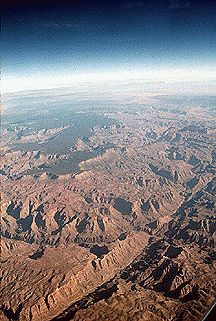 |
That much water coming down from the sky and up from "the springs of deep waters" so quickly, then flowing away so abruptly, would surely do tremendous damage (think tsunami billionfold.) It would cause washes like the Grand Canyon. Scientists say that that immense canyon formed very slowly by gradual erosion from a rather minor river. They could be wrong; if the tableland had been widely fractured first, perhaps this canyon (and the few others like it) could have appeared rapidly. Of course, if a canyon is sinuous, meandering in riverine fashion across otherwise flat land, it has to have formed more slowly. A torrential flood would more likely erase an existing meander rather than deepen it.*
It is interesting that Noah relates that the tallest mountain was covered to a depth of 15 cubits (about 22 feet). For a mountain, let's say, 17,000 feet high (Ararat today) that means it was overwhelmed by a factor of .0017, or 1/772 of its height— just barely made it! As described, the ark might have had a draft of about 22 feet, so one could wonder if this was simply Noah's way of saying that the ark didn't ground on anything at the time, and looking out, he couldn't see any mountains, just water to the the horizon, as far as he could see. Or did God inform him, "there is one mountain [Everest] far far away that is covered to a depth of 22 feet," putting nearby Ararat a good 2 miles underwater? Which suggestion seems more plausible?
What are we trying to say? That the Flood is a myth? Not at all. Jesus clearly spoke of it as a real event and as a warning that something even greater is to come. (Matt 24:37-42) God exists, men ruined their world, God acted, those men perished. Abundant violent water was involved, only those in a protected vessel survived. Those basic features of the story cannot be disproved by physical evidence. But clear and reasonable evidence shows that some of the peripheral details must be incomplete as related. We should not have to deny sound evidence in order to have faith.
Some have said that since the flood was the fall of water accumulated in the upper atmosphere, the world was warm like a greenhouse before that, that it was temperate to the poles. To them this explains the verse that seems to say there was no rain until the Flood (Gen 2:5, 6). Unfortunately, there is strong evidence against that interpretation. Many rivers are clearly older than 4000 years, and great rivers are not fed entirely by dew. They require either rain or snowmelt. The fact that the same rivers existed before and after (as Genesis itself says) militates against that severe a climate change or landform adjustment. Further, we know woolly mammoths existed before the Flood. Why were they woolly? Because it was cold where they lived. From the food found in their stomach we know what they ate: subarctic flora, which is cold-climate vegetation. Clearly, many died in freezing floods alongside watercourses that still exist. If these quick-frozen remains date that far back (and scientists of course date them as much older), to produce them the Flood would have had to change the local climate from very chilly and damp to a hard permafrost lasting for centuries, yet not damage the landscape very deeply. It does not look like it was 5 miles underwater for a year.
On saving all the animals on an Ark: there is an enormous variety of species on earth, many of them being unique to isolated islands and continents, far away from Noah. For example, Madagascar has numerous odd animals found nowhere else, and fossils prove that these have been there longer than 5,000 years. Nor is there any indication of an abrupt break in the kinds of species there. Did God bring to Noah all these thousands of minor variations, then send them all back to their ecological niches afterward, and miraculously recreate their homelands just for them? That does not seem reasonable.
So did Noah save animals or not? Of course he did. Anything less would eviscerate the story; that is one of the key elements, justifying the size of the Ark. Clearly the deluge was sufficient to eliminate all the people God wanted dead, which meant it was a truly terrible event, so it did heavy damage to the land animal population as well. For his sake, God had Noah save a starter set of animals. As far as Noah knew, nothing else survived anywhere, so that is how he wrote the story. The physical evidence indicates that far away, where no people lived, God made other provision for many animals. That in fact would have been far easier for him than to cram every species in existence on the whole planet into a tiny box and then redistribute them back (including across vast oceans, so not by walking!) exactly where they came from afterward.
Some suggest that the ark contained only representatives of each family, say one kind of primate, one kind of canine, etc. Such a near-total loss of biodiversity would readily be discernable in the fossil record, unless it was extremely brief. There is, in fact, strong evidence of not just one, but several global extinction events; not that utterly extreme, but with permanent loss of species.* If there had been an extreme biodiversity bottleneck (not to mention habitat holocaust) a mere 4,500 years ago, then to account for the continuity of species we see in the record, God would have had to quickly repopulate all the farflung corners of the earth just as they were before the Flood, re-creating all the multitudes of species and subspecies and carefully rebuilding all their unique habitats, even some very delicate environments like river deltas and rain forests, down to the exact location of marshes and forests. Could he have done that? Sure, he can do anything. But would he have? That would be hiding the evidence of his bringing the Flood. Why would he do that?
In trying to balance solid scientific evidence with the Flood story, we can take one of three choices: (1) The story is false, and with it collapses the rest of the Bible. The Bible becomes no more than the wisdom of men, mixed with a lot of myth and fable. This is the choice many make, but it is wrong. (2) The story is absolutely perfect as written. Ignore physical evidence, do not examine it or trust it, it will only mislead you. Close your eyes, cover your ears and hum loudly if anyone wants to reason with you. Or drive them away, they are infidels. This is the choice made by the bug-eyed Bible-thumper and the terrorist fanatic, but it dishonors God. (3) The story was fundamentally accurate from the perspective of its writer; something like that actually happened. Still, there are details not included in the story as it came to us, observable reality that it does not account for. In that sense it is incomplete, but understood correctly, it has not been invalidated. The lesson it teaches is still critically important today. This is the rational and faithful choice.
This may be the thorniest example of a Bible account that is hard to square with solid evidence. We discuss this not to damage your faith but to make it more resilient. We will not tell you to ignore science. On the other hand, be careful not to trust it blindly either. Highly interpretive sciences such as archaeology and paleontology are naturally more subject to bias than harder sciences such as physics and chemistry. Beware that some scientists are not as neutral as they claim: some hate faith and will twist their "research" to break it. But most are more agnostic; they are just trying to see what is real, what is there, not trying to prove anyone wrong or right. Their conclusions may be tentative, but the objects they find and the measurements they make are usually not lies. God permits Satan to lie as loudly as he wants, but He doesn't allow him to warp reality itself. Therefore, our faith should not simply ignore it. You can believe the Bible and be a scientist too.
Let us now look into God's Word to learn about God himself.
Review Questions | Back to top